Studies
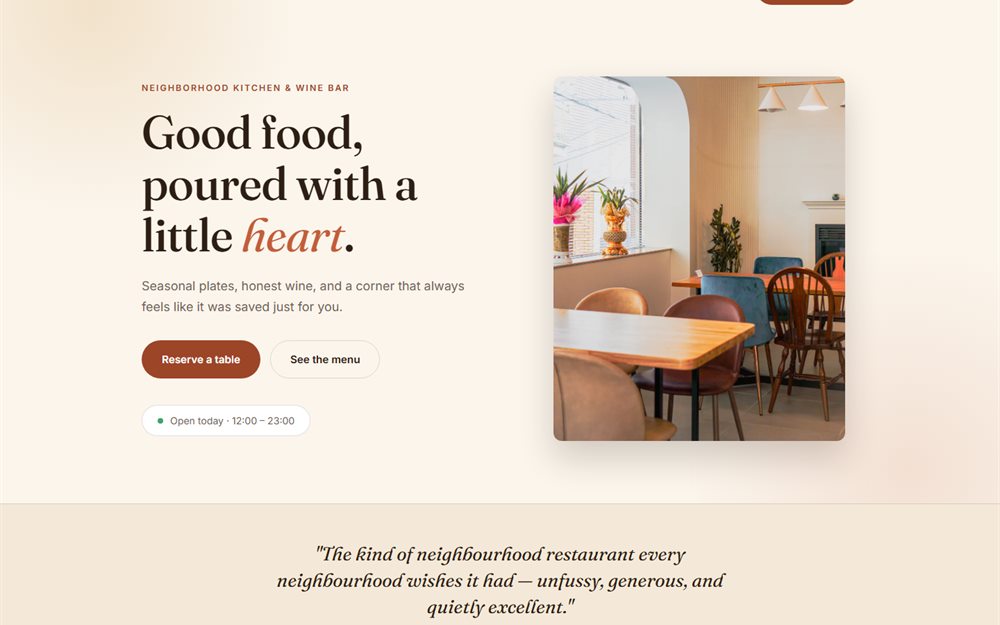
The Corner Table
A neighbourhood restaurant whose menu is illustrated, not photographed — nine dishes drawn as SVG.
The brief
A study. The Corner Table is not a real restaurant. It was built to solve the problem almost every small restaurant actually has: the food has never been professionally photographed, and it isn't going to be.
Restaurant sites live or die on appetite, and the standard answer is stock photography of someone else's food. Customers recognise it, and it quietly says the place isn't proud of its own.
The constraints
- No food photography, and no budget for a shoot. The usual foundation of the entire genre, unavailable.
- The menu changes. Whatever carries a dish has to be cheap to produce again next season.
- A menu is read differently at different times of day, and a single long list serves none of those readings well.
The decisions
Nine dishes, drawn rather than photographed
Each dish is an inline SVG illustration in a consistent hand. Drawing sidesteps the problem instead of faking a solution: it can't look like stock photography, it stays sharp on any screen, it weighs almost nothing, and a new dish costs a drawing rather than a photographer.
What it costs: illustration is a real skill and a real hour. It is also the reason the site looks like this restaurant and not like a template.
The menu is split by day-part
Tabs for the different services, rather than one scroll. Someone deciding on lunch should not be reading the evening list to find out whether it's worth walking over.
What it costs: content is hidden behind a control, so the tabs have to be obvious enough that nobody misses a whole service.
Reservations and private dining are on the page, not behind an email address
A reservation form and a section for events and private hire, because those are the two highest-value enquiries a restaurant site receives and both are usually buried behind a mailto link.
What it costs: a form is a commitment to answering it.
Built with
- Hand-written HTML & CSS
- Inline SVG illustration
- Native details/summary FAQ
- Cloudflare Pages
The FAQ uses native <details> elements, so it opens, closes and is reachable by keyboard with no JavaScript at all — and it still works if a script fails to load.